
The Sardine Run of Baja: Nature’s Underwater Dance

At first glance, the Pacific off Baja California Sur doesn’t give much away. It can feel empty and almost subdued. However, every autumn, that surface calm hides one of the most concentrated wildlife events in the eastern Pacific.
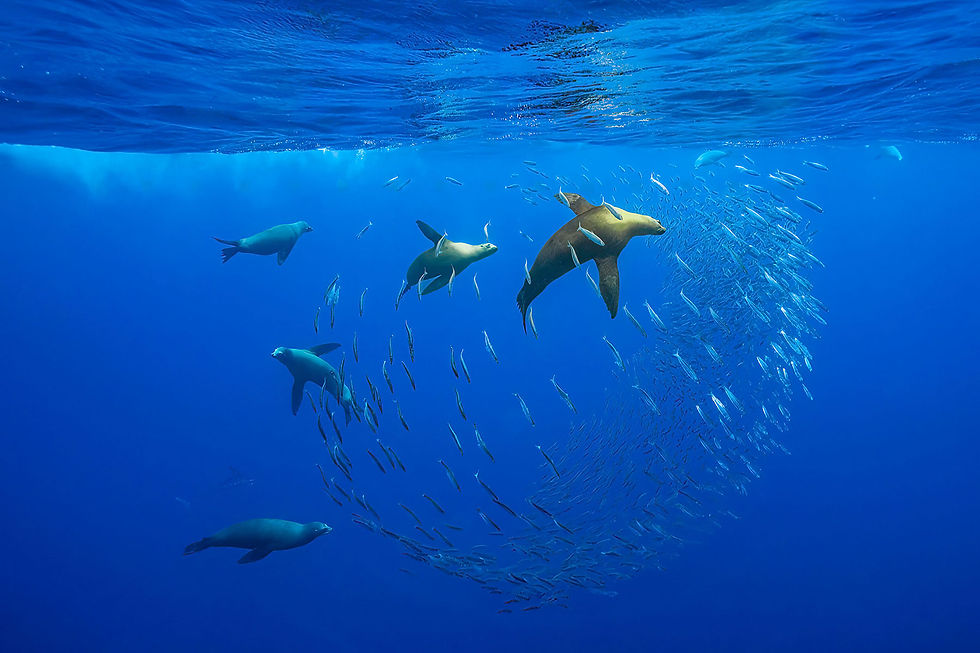
Recently, I went there to photograph the annual "sardine run," when massive schools of sardine and mackerel migrate, creating large bait balls that attract huge numbers of predators like dolphins, sharks, whales, birds, marlins, and sea lions in a feeding frenzy. Check out the video below to learn more about my amazing experience there!
If you have any trouble watching the video above, you can also watch it here.
When the Bait Comes Together

The foundation of the sardine run is the bait ball. Millions of small fish compress into dense, shifting formations that move as a single organism. From the surface, the water darkens and flashes silver as the school turns. From below, it’s even more striking.
What makes Baja special is how exposed everything feels. There’s no reef and no visual clutter. Just open water. When action happens, it happens close, often right at the surface.
The region around Magdalena Bay remains relatively undeveloped, and that remoteness matters. There’s a sense that you’re witnessing something that hasn’t been polished for visitors. Conditions change constantly. One day brings calm seas and blue water. The next brings wind and reduced visibility. You work with what you get!
Getting There and Why It’s Easier Than You Think
Despite its remote feel, the Baja sardine run is surprisingly accessible for travelers based in the United States. Most trips begin with a direct flight to Los Cabos or La Paz, both of which offer regular connections from major U.S. cities. From there, you'll need ground transportation to head north and west along the peninsula to the Magdalena Bay region.
Logistics are typically handled by local operators who specialize in the sardine run. Accommodations are simple but comfortable, often in small coastal lodges or camps close to the launch points. Boats are usually pangas, well-suited for quickly responding to changing conditions offshore.
Once on location, daily routines are straightforward. You can expect early mornings and long days on the water.

Timing and Underwater Photography Requirements
The sardine run typically unfolds from mid October through December, though timing can shift depending on ocean conditions. Cooler water and seasonal upwelling support large concentrations of baitfish, which in turn attract predators. Water temperatures usually sit in the mid 70s to low 80s. Early mornings and long days on the water are the norm.
In my opinion, the underwater world of Baja is a wide-angle environment. A solid underwater housing is essential, along with a streamlined setup that’s easy to maneuver in open water. Fast autofocus and strong low light performance can help a lot when action unfolds quickly. During my photoshoots, the following pieces of gear were essential:
An underwater camera housing made by Ikelite.
Tamron's 16-30mm lens, which allowed me to go wide enough to capture the action even when I was in the middle of it all. This lens is sharp, with responsive autofocus.
To keep up with the non-stop, frenetic action, I used a pair of Delkin BLACK media cards, which are ultra-durable, high-performance memory cards delivering blazing fast read and write speeds.

Physical Demands and Skill Level
Snorkeling is the best way to photograph the sardine run. Freediving experience helps but isn’t required, as most encounters with wildlife happen right at the surface. What matters most is staying calm and listening closely to your guides. You’ll spend a lot of time swimming, snorkeling, and free floating in blue water, often near large, fast-moving creatures. Strong basic swimming skills are essential, but you usually don't need to swim long distances, especially if you encounter a "static" bait ball which isn't moving fast because the fish are tired after being pursued by predators. Most photographers are comfortable in a 3 mm to 5 mm wetsuit, depending on personal tolerance and time spent in the water.
Days can be long, with repeated water entries, extended exposure to sun and wind, and possibly hours spent bouncing over the waves when the weather is rough. A reasonable level of health and fitness goes a long way toward making the experience enjoyable.

The Photo Experience
The sardine run has a way of sharpening your instincts. Everything moves, often at high speed, and you’re forced to react in the moment, and do your best to anticipate the action.
Photographing here teaches you to read behavior, to watch how bait balls compress before a strike and how marlin angle their approach. You learn quickly that timing and positioning matter most, and that patience often produces better images than constant movement.
Changing camera settings on the fly underwater can be challenging, so I set my shutter speed and aperture before hitting the water to give me good results no matter what conditions I encounter. Even though the action isn't always fast, I use 1/500 second to ensure I get sharp images whenever the action speeds up. I stop down to f/8 to increase my depth of field, as images often have multiple animals in them at different planes of focus. I use auto ISO to keep up with fast-changing light. I typically set my exposure compensation to -1, to ensure I don't overexpose important highlights. These settings might not be ideal for every single encounter, but since light and other conditions can change radipdly, it's best to be prepared for the most extreme possibilities.
Even on days when the action is limited, the environment itself has a way of resetting your creative perspective. The scale and the rawness of the experience linger.

Conclusion
For photographers and ocean lovers willing to work in open water, Baja offers photo opportunities that are difficult to find in other parts of the world. When you find yourself suspended above a living storm of silver, with predators cutting through from every direction, it becomes clear why this experience is so special.
Here are a few more of my sardine run favorites!


.jpg)


Comments